
Are you struggling to help a team reach its full potential? Most team development models assume that for a team to be “high-performing,” members must work in a tightly-knit, interdependent way. But what if that conventional wisdom is wrong?
In this post, we’ll explore the Team Performance Curve and reveal how this classic model doesn’t suit all teams. Indeed, by assuming it works for all teams, you may make things unnecessarily harder for many teams in organisations.
At OCH we distinguish between two fundamentally different team types:
- Interdependent Teams achieve results through members working directly together to produce a shared outcome, like a project team
- Extra-Dependent Teams achieve results by applying specialist expertise outside the team, supporting individuals, teams or the wider organisation. For instance a team of project managers.
This distinction becomes important when we consider how teams develop over time.
In their seminal work, The Wisdom of Teams, Katzenbach and Smith (1993) provided a foundational definition that is still widely used in team coaching today: “A team is a small number of people with complementary skills who are committed to a common purpose, performance goals, and approach for which they hold themselves mutually accountable.”
The Team Performance Curve
To map the journey from a working group to a high-performing unit, they developed “The Team Performance Curve.” This model tracks the evolution of teaming behaviours through a series of linear steps:
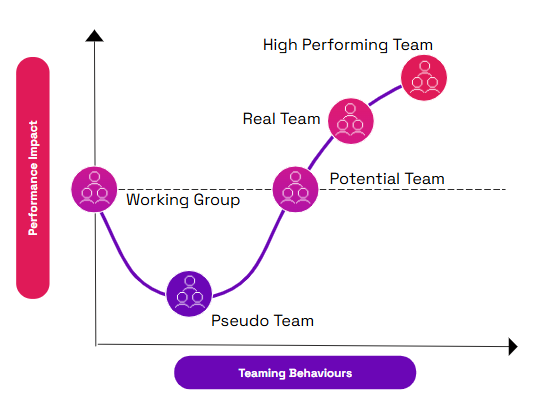
- Working Group: A group of people individually contributing. The sum will never be greater than the individual parts. The value of teaming isn’t being achieved.
- Pseudo Team Dip: The team attempts to act like a team but hasn’t yet gelled. Performance often dips here because the group invests time in “teaming” at the expense of actual output. While teaming behaviours increase, performance initially decreases because the group has not yet learned how to convert those behaviours into improved results.
- Potential Team: Teaming behaviours improve, but performance remains on par with the initial Working Group.
- Real Team: Synergy occurs; the sum becomes greater than the individual parts due to working together and generating interdependence.
- High-Performing Team: The ultimate stage, where the team consistently out-performs its peers.
This linear progression mirrors Tuckman’s “Forming, Storming, Norming, Performing” model, suggesting that friction (storming) is a natural part of the growth process.
Extra-Dependent Teams
Extra-Dependent Teams don’t immediately fit into the Team Performance Curve. Katzenbach and Smith were only interested in interdependent teams. Indeed, Extra-Dependent Teams were only discovered later. One of the most obvious behaviours of the teams Katzenbach and Smith were focused on is working together – seeing the team interacting directly to achieve a common performance goal. Such behaviours include finding ways to combine each other’s specialist skills and knowledge and also holding themselves mutually accountable through checking each others’ progress and providing feedback and support. But these behaviours aren’t the same in Extra-Dependent Teams.
Unlike traditional interdependent teams, extra-dependent teams consist of people who share the same specialist skills. So rather than depending on differences, such teams consist of similarities. And they mostly perform apart. Because they provide their in-demand skills to teams outside of their immediate circle (hence the term Extra-Dependent). There is nothing wrong with this. Such teams are found in most organisations, from large to small – doctors, lawyers, project managers, leaders, sales people, etc. But because they are constructed around similarity, expecting them to develop and behave like an interdependent team of difference isn’t helpful. Indeed, if you try to make an Extra-Dependent Team work together more, like an interdependent team, they will struggle to perform. In effect they become the Pseudo team with the corresponding drop in performance, but without the possibility of moving into Potential Team – because their design and raison d’etre isn’t interdependent. It’s extra-dependent.
The Plural Development Curve
We propose that both teams can be high performing, but that they both need to develop differently to achieve the same result. We illustrate this with the Plural Development Curve.
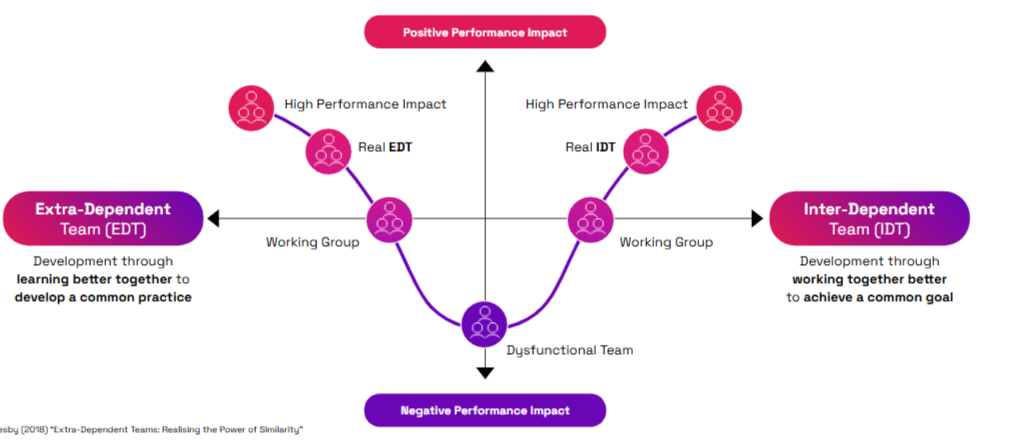
For Interdependent Teams: Developing interdependent teaming behaviours such as working together and depending on differences, means progress is made on the right hand side of the curve.
For Extra-Dependent Teams: This is shown on the left hand side of the curve. High performance is generated through collaborative learning together. These teams thrive when they spend quality time sharing knowledge, skills, hints and tips and generally improving the consistency in their individual practice. It’s a fundamentally different development process. And this is why we have it leading in a different direction on the Plural Development Curve.
Both pathways can lead to high performance, but they do so through very different teaming behaviours. This is why we pay so much attention to the different types of teams and the true nature of the development process that needs to occur within the team to improve its performance.
Rethinking Your Team Coaching
The biggest takeaway for leaders and coaches? Don’t assume every “Working Group” needs to become an interdependent, high-performing team to succeed. There is no single direction for developing a team. Check the type of team it is before committing to how and why it needs to develop.
For instance, some teams that are believed to be Working Groups, might actually already be on the way to being Extra-Dependent Teams. By correctly identifying your team’s type, you can bypass the “Pseudo Team” performance dip entirely and adopt a development path that aligns with how your team actually functions.
Want to Learn More About Team Dynamics?
We offer resources to help you master these nuances, including free e-learning, community forums, and professional development.
Explore our Mastering Extra-Dependent Teams to learn how to stimulate the right kind of collaboration and unlock high performance in your organisation.